
'Try not to compare yourself with others, it's much healthier and more sustainable to focus on yourself and try and make more positive choices.' - Evan Lynch
Evan Lynch is AG1’s Director of Product Marketing, Content and Nutrition in Europe - and his perspective on health and habits was shaped long before he joined the company.
A former semi-professional track and field athlete, sports specialist dietitian and PhD student, Evan has worked with elite athletes across three Olympic cycles. Today, his focus is less on chasing marginal gains and more on helping people build simple, repeatable habits that fit real life. Which makes Evan a perfect fit for AG1.
In this eye-opening Q&A, Evan explains why he advises against New Year's resolutions, how AG1 empowers people to take ownership of their health, and why athletes and non-athletes are not so different.
THE IMPORTANCE OF SIMPLICITY AND REPETITION
If I look back at my life as an athlete, ironically, I made loads of very poor decisions purely because a) I didn't know what I was doing and b) I assumed it was really complicated. So I only looked for and took on board complicated answers. And I really wish I hadn't done that. If I could have gone back in time and just focused on my sleep quality, or focused on taking a supplement that ticks all of my boxes just in one fell swoop, alongside eating and training well, I would have done those easy wins that you get a lot from, versus spending lots of my time and attention trying to find marginal gains where there were none. I think a lot of athletes get caught up in optimising that they miss the forest for the trees, which is a real pity.
So now I've come full circle and I've really dialled back in on two key aspects of nutrition - simplicity and repetition, building foundational habits. Things that you can easily do every day, that's the stuff that's going to drive performance. Lesson learned. Slightly too late for my athletics career, though!
WHY ATHLETES AND NON-ATHLETES AREN'T SO DIFFERENT
So when you look at athletes and then you look at 'normal' people or non-athletes... people tend to put themselves in either camp, but I see everyone the same, that we all perform and our version of performance looks different. For me today, for example, I have three kids, a wife, bills... I'm not trying to train for a World Championship or the next Olympics, but the demands on my body and mind are still high. You take an athlete, you take a 'normal' person, they've got busy days, they both experience strain and stress, just in different formats. When it comes to health behaviours or ticking the boxes for ourselves, that's actually extremely relevant for both groups, it also needs to be very easy to do, for both groups.
Here's what I mean by this: I'm going to use a term - executive functioning, the psychological process of making decisions. The way I would explain it to a patient: think of your brain as a car park. Every decision you make is a parking space. If you're me now with kids, the car park is full by half nine in the morning. You can't think, you can't do any psychologically complex processes or multi-step processes after that. Forget about it. But I still need to perform. My partner still needs to perform. Most people doing ironmans or marathons are in both camps. They're trying to excel in a sport and they are trying to navigate family life - it’s a tough balance, so the last thing someone needs is an extra chore to do.
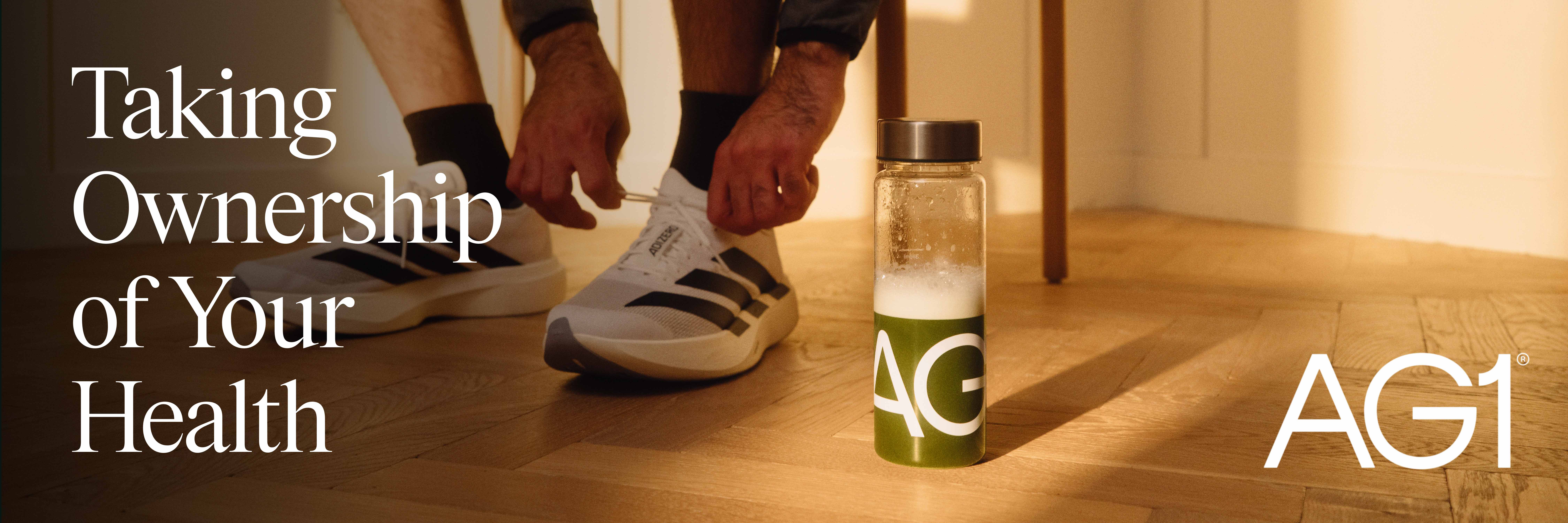
TAKING OWNERSHIP OF YOUR HEALTH WITH AG1
Something I saw as a practitioner and still see to this day, is that people are very black and white with their day, with their thinking. If you start off your day badly, if you have a chocolate bar for breakfast, that's probably not a great start. Most people don't go uphill from there. They stay at that or the day gets worse. And people are going to read that and that's going to reverberate with them. But if you have a ritual to start your day, if it's AG1 first thing in the morning, you feel as though you are taking positive steps before you've even put your slippers on. It's a very good start. You can build off of that momentum, and you kind of have a more positive disposition towards the rest of the day. And while that might be intangible for most, the value is actually very real there, because when we look at psychology, if you make a bad choice, it's much harder to then follow it up with a good choice. But if you're starting on a positive, it's far easier to stay on that train.
So I think with AG1 users, my impression is they probably have generally healthier days because of how the day starts. It sets the tone, it sets the precedent, and that just owes to better consistency. Health is a continuous process. Being healthy is contingent on consistently taking steps to improve your health. So if you start with AG1, you're far more likely, I think, to be more consistent in that department.
WHY SELF-IMPROVEMENT HAS TO BE EASY TO MAINTAIN
If we're trying to get people to make health decisions forever, they need to be very easy. They need to have the least amount of thought possible - I'm talking about cognitive load. That's why I'm captivated by something like AG1, because we put a lot of thought into it, so the consumer doesn’t have to. It's very easy. You don't really have to think about it. It's not passive, but it's as close as it can be to passive and ticking many boxes at the same time. And I think that's invaluable. And I do think that there's a lot to be said for looking for steps like that that people can take in. I do think that's why AG1 is so popular and has such longevity with its user base. It's a real good example of low executive functioning for high marginal yield.
AVOIDING THE PRESSURE OF 'NEW YEAR NEW YOU
You know, as a clinician, I'm not really into 'new year, new you'. I never forget this phrase that I heard from a psychologist. I had said something like 'new year, new you', and she said, 'you know, wherever you go, there you are.' And so you're just going to be yourself, struggling with your day to day life in January. With this added pressure of 'God, I need to make a change now arbitrarily, just because it's the 1st of January.' I don't think people need that pressure.
For people reading this, who are really gung-ho on 'new year, new me', I would challenge you to pause for a second and say, 'okay, do you know what? Not new year, new me. How about me trying to be better than I was yesterday?' That's the only game we play. AG1's mission in general is more congruent with that way of thinking. We don't need to change you as a person. We just want to help you be the best version of yourself, 365 days a year. And it pops into focus around now for a couple of reasons. But that would be my advice to someone looking to make a New Year's resolution: don't. Think about it slightly differently.
FOCUS ON YOURSELF, NOT OTHERS
Everyone has a different starting point but, as far as I'm concerned, a healthcare journey doesn't have an end point. It's a continuous process. It's there forever. And it's important that we treat it like a garden almost, and cultivate it. There's no point in looking over the fence in someone else's garden and comparing your roses to their roses. When we look at health psychology, there is a framework called down-rank comparison or up-rank comparison, where we look at people who are ahead of us or behind us and our goals, and we try and figure out where we sit on that continuum. Social media tells us to do that all the time. Be faster than the guy next to you. Be the strongest dude in the room.
It's much healthier and much more sustainable to zoom in and focus on yourself and just try and make more positive choices. Do right by yourself and be better than you were yesterday, or do better than you did yesterday and forget what other people are doing. Look to athletes as a source of inspiration and motivation to see what is possible. As soon as you stop comparing yourself to others and you live your own journey, the process gets an awful lot more enjoyable.
Jimmy Carr actually put it really well: it's not the pursuit of happiness, it's the happiness of the pursuit. So to reiterate, you're going to be focusing on your health for the rest of your life. I know if I picked two people, one of whom was approaching this from the point of view of, I'd like to be as healthy as possible to live my best life versus person two, who says I want to be the strongest, scariest guy in the room. I know for a fact which one of those has a more enjoyable life. Both of them still end up being physically healthy people. Only one of them is a mentally healthy person. So I would say be more person A than person B.